
Pre breeding bull checks are an important part of herd reproductive management and help ensure productivity and profitability of the herd. Identifying sub fertile bulls early reduces the risks of economic losses associated with low pregnancy rates and helps ensure more predictable and tight calving schedules.
A bull breeding soundness exam consists of three stages; a crush side physical examination, a crush side sperm motility evaluation (analysed using the iSperm) and finally, a sperm morphology evaluation which is performed in a laboratory. While we see an array of different abnormalities, here is a summary of some of the more common ones we find, a brief run down of what causes them and what they mean for you and your bulls.
Bull Proximal and Distal Droplets

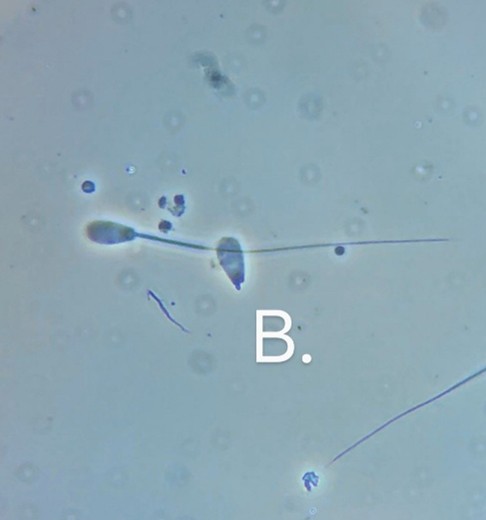
Distal Midpiece Reflexes (DMRs)
DMR are one of the most common abnormalities seen in bull sperm analysis. Various factors can cause the abnormality, including heat, stress, trauma or incorrect sample collection/ handling. When seen in less than <20% of ejaculate and there are no other abnormalities, they are not a huge cause for concern. They are known as a ‘compensable abnormality’, meaning that we can compensate for this abnormality by adding more semen to increase fertility. As the sperm are unable to swim, they cannot compete with healthy sperm so will never be able to fertilise an ovum.
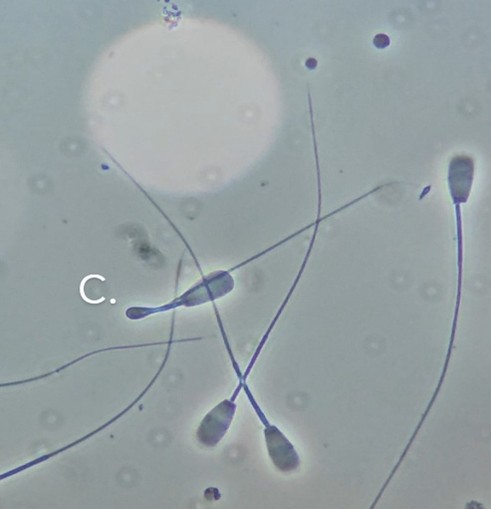
Loose Tails/ Decapitated Heads
Heads detaching from tails can be caused by various factors, including heat stress or trauma to the epididymis or ampullae. However, they are also very commonly seen in ‘rusty loads’ of bulls who have not been working and regularly ejaculating. If a large percentage of this abnormality are seen in conjunction with poor crush side motility, then a second or third sample should be collected to see if this improves. It normally does.
Vacuoles
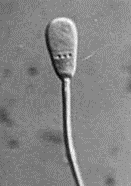
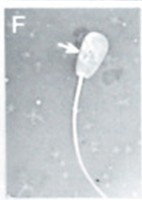
Vacuoles can be anything from a single subtle crater to multiple large ‘bite like’ craters across the sperm head. Small, subtle ones are only detectable under a phase contrast or DIC microscope. They occur during the final stage of spermatogenesis and can be a result of stress events like acidosis or heat stress. Bulls with high percentages of these abnormalities (>20%) are suggested to have poor pregnancy rates, but the jury is still out on how it impacts fertility. Sperm cannot bind to the ovum (large vacuoles) but if they do (small craters) the disruption to the DNA may cause early embryonic death.
References
Perry, V., 2018, A Refresher on Sperm Morphology, AVA Annual Conference, Brisbane 2018
Beggs, D., et al., 2024, Bull Check: A Veterinary Bull Breeding Soundness Evaluation, 4th Edition
De Graff, S., 2025, Livestock Semen Assessment Course Handbook, University of Sydney NSW