
When rearing calves, whether it be 3 or 300, some general principles are relevant to all systems. The first few months of a calf’s life is critical, especially when they are your future milking herd animals in a dairy system. However, the first few months of a beef calf’s life is just as crucial when setting them up for good growth rates.
To rear healthy calves, we need to start by considering the mother. Dry period management, “transition” diets, milk fever prevention, rearing heifers to target calving weights and bull selection are important factors to reduce calving and post-calving complications. Dams should be vaccinated at least 6 weeks prior to calving to ensure antibodies passed to the calf in colostrum are plentiful. Generally, we are referring to a 5 or 7 in 1, but there are other vaccinations available for the mother as well to help reduce calf scours.
COLOSTRUM!
Remember the 4Q’s – Quality, Quickly, Quantity and sQueaky clean
If your dam neglects the calf or the calf is not suckling, consider you may need to strip and feed colostrum to the calves yourself. This process must be done as cleanly as possible to avoid mastitis in the cow and contamination of the milk.
Calves should get colostrum within 4-6 hours of birth because their intestine absorbs immunoglobulins in this time, which starts priming their immune system. As a ‘rule of thumb’ calves should receive 5-6% of their body weight in colostrum within their first 24 hours of life. Begin with 4L within 2 hours of life then distribute the remainder over the 24 hour period (no more than 4L at a time). Absorption by the gut is maintained to varying degrees for 48 hours, so it is still worth persisting until this point. If the dam has insufficient or poor-quality colostrum, consider asking local dairy farmers if they have any fresh or frozen. Powdered artificial colostrum can be used but it lacks some vital immunoglobulins. A plasma protein test on calf blood at 48 hours can tell you if sufficient immunoglobulins have been absorbed.
Step by step colostrum collection and feeding:
- Wash hands and wear gloves. Ensure collection buckets, feeding and storage bottles are thoroughly cleaned and sanitised.
- First, strip a small amount of milk from each quarter and look for blood, clots, or abnormal thickness. If these abnormalities are present, then this could indicate mastitis. Call your vet if this occurs. We sometime have colostrum available at the clinic.
- If milk looks normal, milk the cow into a clean, sanitized container
- Assess quality using a Brix refractometer à if >22% or greater this indicates excellent quality.
- Warm colostrum to approx. 38°C by placing a bottle of colostrum in a warm bucket of water.
- Feed to calf using clean nipple bottle
- If the calf is weak, unable to suckle, or refuses the bottle then you may have to administer via a clean oesophageal tube feeder. ONLY do so if you are experienced performing the procedure, if you are not then give your vet a call.
FEEDING
In most cases calves should be fed twice daily for the first few days. Twice daily feeding allows higher daily intake of milk and will help to reduce the incidence of scours and bloat, promoting a healthier digestive system and therefore increasing growth rates. Average daily intakes of milk should be between
10-15% of bodyweight daily. This means that a 50kg calf should be receiving at least 4L of milk daily or up to 2.5L of milk twice daily.
Good milk replacers will have average protein and fat levels of 20% or more. Low protein levels will lead to lower growth rates; low fat levels will result in poorer digestion and increased scouring, and therefore lower growth rates. Do not dilute milk replacer more than recommendations.
Consistency is essential – stick with the same milk replacer, at the same temperature, and the same number of feeds and only make changes slowly over a few feeds/day. If you need to transition a calf from mother’s milk to substitute milk then start with smaller feeds more often and be prepared this can cause nutritional scours.
Calves should be offered pellets and hay from 1 week of age. Although calves eat and utilise very little of this early on, it is essential for gut development so it should be offered. When feeding concentrates keep it fresh and palatable, otherwise it won’t be eaten, and always provide plenty of fresh clean water. Concentrates should be high in energy and protein (19-21%), with plenty of by-pass protein (e.g. heat-treated soybean meal, canola meal and cottonseed meal). Feeding a diet containing rumensin is a good idea to reduce incidence of bloat. A minimum intake of 500gms of concentrate daily by weaning is ideal. Make sure there is always water available.
WEANING
The rule of thumb is to wean at double birthweight. Most farmers in this area wean at 10-12 weeks of age. Early weaning can occur from 5-8 wks of age – with a target range of 65-80kg depending on the breed. The month after weaning is critical as adequate hard feed intake is required to maintain growth rate. Supplementation with a good quality concentrate is necessary to maintain growth rates – there are many rations that are suitable pre and post weaning. The important elements are high energy, high protein (with high by-pass protein so many lush pastures are not good enough) and sufficient Calcium and Phosphorous. Beware trace element deficiencies. Preparations containing rumensin are a good idea.
Weigh your calves regularly and make sure they are weaned at appropriate weights and then continue to grow. You should aim to maintain your calves at Condition Score 5 (on 1 – 8 scale) and can measure heights regularly and compare to growth charts.

PRINCIPLES OF CALF REARING
SHELTER
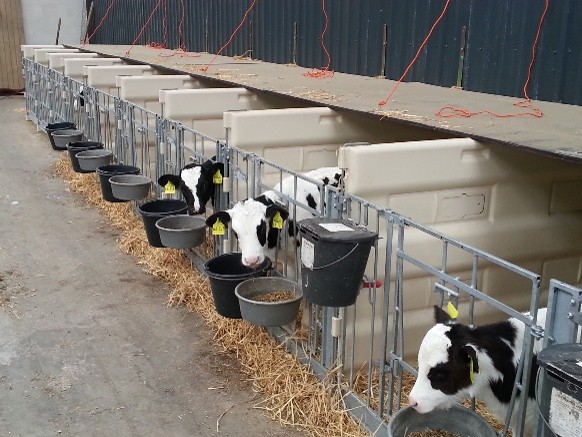
Some form of shelter must be available to calves year-round. In summer, shade is essential as calves will dehydrate quickly, especially if scouring, or not drinking for more than 24hrs. In winter, protection against the elements, especially in calves less than 8 weeks, is an important method of reducing stress and susceptibility to disease.
OVERCROWDING
Overcrowding is a common problem. This will result in a rapid concentration of pathogens in a small area, both in the air and on the ground. This will rapidly lead to a breakdown in hygiene and increase the incidence of parasites and increase transmission of diseases much quicker in an overcrowded system.
WATER
It is essential that water is available to all calves from day 1. This will help them cope with mild diarrhoea better, prevent dehydration in summer months and generally improve calf health. All water should be clean and fresh.
HYGIENE
Good hygiene will prevent many diseases, especially those causing scours. If using confined pens it is important to clean and disinfect these prior to the introduction of a new batch of calves. Ensure that bedding is replaced where possible – this will be the main source of contamination in the pen. Any sick calves should be kept separate to slow disease spread. It is best to keep similar age animals together and adapt an “all in and all out” system, with removal of all old bedding and thorough cleaning between different batches of calves.
Two main problems can arise in paddock systems. Firstly, if the paddock is used all the time, year after year, a natural build up of pathogens will occur in time, and the potential for problems is very high. The second issue occurs in dairy systems where calves are close to the dairy. If there is any run-off from the dairy onto the calf paddocks, calves are at a very high risk of disease. Rapid spread of Johnes disease is very common in these situations. If managed on an extensive or rotation basis the paddock system can work very well.
VACCINATIONS
Vaccinations are highly recommended in all calf rearing systems. The cost per calf is minimal, and the benefits are high. 5-in-1 or 7-in-1 preparations are best, and should be given at 6-8 weeks old, and again at 10-12 weeks old. Subsequent vaccinations are yearly. 7-in-1 vaccinations will prevent Leptospirosis. This disease is normally a problem in adult cattle, but outbreaks in calves and humans do occur.
Vaccinations against E. coli, rotavirus and salmonella are also available (main diarrhoea pathogens). The protocol involves vaccinating the cows 2-6 weeks prior to calving then feeding the calves on stored colostrum. This only works if the 4 Q’s of colostrum intake are adhered to.
WORMING
Worms can cause scours and ill thrift even in young calves. Faecal worm egg counts (FEC) are an easy way of diagnosing a worm problem and we can do this in-house. As many parasites are gaining resistance against drenches due to historic misuse, we recommend a follow-up FEC two weeks after any drench to ensure the drench has worked.